Curriculum Unit: LatinX Art and Identity in Atlanta
Kelly R. Rollocks
ARH6390: Art and Global Diversity
Dr. Pamela Brekka
December 13, 2020
Lesson Title: Curriculum Unit: LatinX Art and Identity in Atlanta
Grade Level: 6th, 7th, and 8th
Overview
Students will study Celebrating Georgia Artists of Hispanic/LatinX Origin at the Museum of Contemporary Art, located in Atlanta, Georgia. Studies will further focus on Melvin Toledo’s ay, Nicaragua, Nicaraguita and Catalina Gomez-Beuth’s Fermin. Both works utilize portraiture to express LatinX identity.
The goal of this unit is to provide students with a means of exploration of their own identities as LatinX students in the United States. The work will serve as a community education display at the school, facilitating the opportunity for faculty, parents, and students to explore and understand student identities. This unit will also be shared with fellow art educators in the district to provide an example for responding to the cultural diversity in the area.
By participating in this learning process, students will make personal connections between local contemporary artists and personal connections to LatinX cultures. Students will explore watercolor painting, contour drawing, and photography as a way to engage in art making processes. By doing so, students will be enabled to engage in deep learning processes because personal connections to learning processes have been made. Additionally, students will articulate and display an artist statement. Artist statements and artworks be displayed and utilized for community education.
This unit is designed in 3 lessons spanning five to six weeks taught to students in 6th, 7th, and 8th grades. The first initial lesson will focus on contemporary LatinX artists in the Atlanta area. The second lesson will focus on creating a self-portrait that facilitates the exploration identity. The third lesson will involve presenting and articulating the results of the previous two lessons.
Rationale
Currently, I teach students in grades 6-8 in Gwinnett County Public Schools, the most diverse district in Georgia. My school, is comprised of 68% Hispanic students. The rational for this unit started when I overheard students teasing one another for being from different Latin American countries, some students favoring their own country and not understanding their peers’.
Media
Mixed Media 2D project
Audience
Students in grades 6-8, Faculty/Staff/Parents of Berkmar Middle School, and art teachers in Gwinnett County, Georgia.
Lesson 1
Enduring Ideas/Essential Questions
Enduring Idea: Informed study of Celebrating Georgia Artists of Hispanic/LatinX Origin at the Museum of Contemporary Art, located in Atlanta, Georgia
Essential Questions:
-
How do the selected artworks approach portraiture?
-
Why is it important for artists to incorporate culture into their work?
-
What kind of evidence is there of culture in the artists’ work?
Learning Standards
FV.A.6.b: maintain instructional information, consult resources, and create notes
FV.C.8: reflect on the context of personal works of art in relation to community, culture, and the world
FV.D.11.a: identify universal themes in works of art from diverse cultures, both past and present
FV.D.13.a: recognize the presence and meaning of visual art in the community
FV.D.13.b: explore the connection between personal artistic creation and one's relationship to local and global learning communities
Lesson Objectives
-
Students will examine contemporary artworks from Celebrating Georgia Artists of Hispanic/LatinX Origin at the Museum of Contemporary Art, located in Atlanta, Georgia
-
Students will understand how identity is connected to culture
-
Students will study Melvin Toledo’s ay, Nicaragua, Nicaraguita and Catalina Gomez-Beuth’s Fermin
Tools and Materials
Students will need sketchbooks and access to the virtual exhibit.
Introduction
Guide students to challenge preconceived notions about generalized LatinX culture using guiding questions. Allow time for students to thoughtfully contribute, while carefully curating the conversation to be inclusive of all diverse LatinX cultures.
Procedure
-
Exhibition Discussion: Lead a group discussion using the following guiding points:
-
Introduce the Museum of Contemporary art and discuss what constitutes work being classified as contemporary.
-
Provide a survey introduction of Celebrating Georgia Artists of Hispanic/LatinX Origin, highlighting the purpose. Share selected works to demonstrate the complexity and diversity of the exhibition using the overview here. (Celebrating, 2020).
-
Introduce selected works:
-
Melvin Toledo ay, Nicaragua, Nicaraguita- Link here. (Toledo, 2018).
-
Catalina Gomez-Beuth’s Fermin- Link here. (Gomez-Beuth, 2017).
-
Artist Videos
-
Allow students to hear artists speak about their work
-
Catalina Gomez Beuth- Link here. (Gomez-Bueth, 2020).
-
Melvin Toledo- Link here. (Toledo, 2020).
-
Guided Analysis: Provide students with the handouts attached in Appendix A. Students should respond in their sketchbooks. Monitor and provide feedback individually.
Distribution and Clean-Up
Sketchbooks are kept and maintained by each individual student.
Select 1-2 students to pass out handouts.
Closure
Check that sketches are complete as a ‘ticket out the door’
Assessment
Teacher will provide verbal formative feedback to students individually as they are sketching
Artists or Works of Art Studied
Celebrating Georgia Artists of Hispanic/Latinx Origin Checklist. (n.d.). MOCA. Retrieved December 7, 2020, from https://2pm1gr34pmjm10f8rg1tqmy4-wpengine.netdna-ssl.com/wp-content/uploads/2020/09/Checklist_Hispanic-Latinx-4.pdf
Gomez-Beuth, C. (2020, April 29). Gomez Beuth Catalina Artist Video. Retrieved December 11, 2020, from https://youtu.be/IP6fUPBBGZA
Gomez-Beuth, Catalina. (2017). MOCA. https://2pm1gr34pmjm10f8rg1tqmy4-wpengine.netdna-ssl.com/wp-content/uploads/2020/03/Gomez-Beuth-Record.pdf
Toledo, M. (2020, April 24). Melvin Toledo Artist Video. Retrieved December 11, 2020, from https://www.youtube.com/watch?v=rN9DjLrh6SU
Toledo, Melvin. (2018). MOCA. Retrieved December 6, 2020, from https://2pm1gr34pmjm10f8rg1tqmy4-wpengine.netdna-ssl.com/wp-content/uploads/2020/09/Toledo-Record-1.pdf
Lesson 2
Enduring Ideas/Essential Questions
Enduring Idea: Informed choices visual representation of cultural identifiers enhance personal expression and communication of LatinX identity
Essential Questions:
-
How do artists visually represent cultural elements in their work?
-
What symbols, imagery, and/or colors are connected to your own culture?
-
What elements do Melvin Toledo and Catalina Gomez-Beuth incorporate into their work to identify their cultures?
-
What role does portraiture play in expressing cultural artwork?
Learning Standards
FV.A.1: visualize and generate ideas for creating works of art
FV.A.1.a: generate ideas by using mental and visual imagery
FV.A.1.b: explore essential questions, big ideas, or themes in personally relevant ways
FV.A.1.c: incorporate a variety of sources as inspiration for works of art (e.g., internal inspiration - moods, feelings, self-perception, memory, imagination, fantasy; external inspiration - direct observation, personal experience, events, pop culture, artists and artwork from diverse cultures and periods)
FV.A.2.c: use technology in the production of original works of art as a medium and/or resource
FV.D.11: develop personal artistic voice through connecting uses of art within a variety of cultural, historical, and contemporary contexts
FV.C.9.a: engage in supportive peer review through formal and informal assessment and idea development
Lesson Objectives
-Students will produce symbolic imagery representative of personal culture
-Students will explore cultural identity by creating expressive portraiture
-Students will become familiar with portraiture by experimenting with photography and contour line
Tools and Materials
Students will need sketchbooks and handouts that accompany this lesson.
Watercolor paper, watercolor paints, paintbrushes, pencil, photography (phone or computer), printer, overhead transparency, sharpie, and glue.
Introduction
Review and discuss contemporary artworks from Melvin Toledo and Catalina Gomez-Beuth.
Procedure
-
Photography: Allow 10 minutes for students to experiment with taking a selfie, or working in pairs to photograph one another. Encourage students to consider how portraiture can be used to represent their culture. When complete, students print a copy on standard copy paper.
-
Symbolism with cultural identifiers:
-
Demonstrate watercolor techniques like wet on wet to encourage students to experiment with color in the style of Catalina Gomez-Beuth
-
Demonstrate watercolor techniques for creating drapery, in the style of the flag used in Melvin Toledo’s ay, Nicaragua, Nicaraguita.
-
Allow the remainder of the class period for students to experiment and explore
-
Allow the next class period to be a work session. Students should create a background expressive of cultural identity
-
Connecting portraiture with culture: Students begin by laying overhead transparency over printed portrait. Students should trace contour lines with a sharpie to render portrait. Students may opt to interpret with creativity, by omitting elements, or filling in solid areas with sharpie. When finished, glue corners to the watercolor background
Distribution and Clean-Up
Sketchbooks are kept and maintained by each individual student.
Select 1-2 students to pass out watercolor paper
Select 1 student to manage passing out/collecting the following: paint, brushes, photographs/transperncy paper, sharpies
Closure
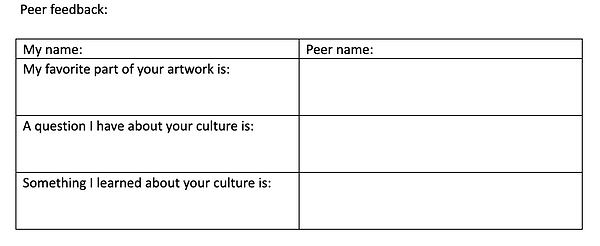
Walk and talk. Have students lay their work on their tables, and spend time viewing peer work. Students should select a peer to complete the peer feedback form below, to facilitate communication and understanding between students.
Students will receive formative feedback from the teacher using the formative teacher feedback rubric below.
Assessment
Artists or Works of Art Studied
Gomez-Beuth, Catalina. (2017). MOCA. https://2pm1gr34pmjm10f8rg1tqmy4-wpengine.netdna-ssl.com/wp-content/uploads/2020/03/Gomez-Beuth-Record.pdf
Toledo, Melvin. (2018). MOCA. Retrieved December 6, 2020, from
Lesson 3
Enduring Ideas/Essential Questions
Enduring Idea: Artwork can serve as an educational tool to open cultural conversations among students, parents, and faculty.
Essential Questions:
-
What do you want viewers to take away from experiencing your artwork?
-
How can your artwork be used to educate others about your culture?
-
How can an artist statement help viewers to understand your work?
Learning Standards
FV.B.7: plan, prepare, and present completed works of art
FV.B.7.a: participate in art exhibits in the school, local community, and/or online
FV.B.7.b: write an artist statement by reflecting on finished works of art
FV.C.9.b: use the language of art to identify how meaning is conveyed in works of art
FV.C.9.c: describe and analyze the aesthetic qualities of specific works of art
FV.D.11: develop personal artistic voice through connecting uses of art within a variety of cultural, historical, and contemporary contexts
Lesson Objectives
-
Students will articulate an artist statement that addresses the cultural elements present in the artwork
-
Students will display artwork in a local school exhibition to educate school community
-
Students will justify the LatinX artist voice at the local level, and compare to the
LatinX voice at the Museum of Contemporary Art
Tools and Materials
Completed artwork, paper
Introduction
Review the work on display from Celebrating Georgia Artists of Hispanic/LatinX Origin at the Museum of Contemporary Art, and the selected works by Melvin Toledo ay, Nicaragua, Nicaraguita- Link here. (Toledo, 2018), and Catalina Gomez-Beuth’s Fermin- Link here. (Gomez-Beuth, 2017).
Lead class discussion. Prompt students to connect the biography statements with the works, and prompt students to question the benefit and purpose of articulating statements to accompany artwork.
Procedure
-
Artist Statement: Students will use handout attached in Appendix B to assist in crafting and articulating a written artist statement
-
Share Out: After artist statement has been written, students will display work and share verbally with peers. Encourage students to discuss and question one another
-
Art Exhibition: Display student work alongside completed artist statements. Invite faculty and parents to view the work at a reception.
-
Teacher Education: Share photographs of this lesson and exhibition with fellow Gwinnett County Public Schools art teachers at the summer institute, along with this lesson plan. This unit should serve as an example for art curriculum that responds to the cultural diversity of Gwinnett County Public Schools.
Distribution and Clean-Up
Select 1-2 students to pass out handouts and paper as needed
Closure
Have students reflect on the exhibition with the following guiding questions.
-
Do you feel that the exhibition was successful?
-
Do you feel that your culture was represented in a way that you feel proud of?
-
Do you think others learned more about your culture?
-
Did you learn more about the culture of others?
Assessment
Project is assessed using the following rubric.
References
Castro, J. (2018, November 14). What It Means to Be 'Latinx,' and What That Means for America. Retrieved November 22, 2020, from https://www.nytimes.com/2018/11/14/books/review/latinx-ed-morales.html
Celebrating Georgia Artists of Hispanic/Latinx Origin Series. (2020, November 03). Retrieved November 22, 2020, from https://mocaga.org/calendar/moca-ga-celebrates-georgia-artists-of-hispanic-latinx-origin-series/
Celebrating Georgia Artists of Hispanic/Latinx Origin Checklist. (n.d.). MOCA. Retrieved December 7, 2020, from https://2pm1gr34pmjm10f8rg1tqmy4-wpengine.netdna-ssl.com/wp-content/uploads/2020/09/Checklist_Hispanic-Latinx-4.pdf
Gamboa, S., Lilley, S., & Cahlan, S. (2018, September 28). Young Latinos: Born in the U.S.A., carving their own identity. Retrieved November 22, 2020, from https://www.nbcnews.com/news/latino/young-latinos-born-u-s-carving-their-own-identity-n908086
Gomez-Beuth, C. (2020, April 29). Gomez Beuth Catalina Artist Video. Retrieved December 11, 2020, from https://youtu.be/IP6fUPBBGZA
Gomez-Beuth, Catalina. (2017). MOCA. https://2pm1gr34pmjm10f8rg1tqmy4-wpengine.netdna-ssl.com/wp-content/uploads/2020/03/Gomez-Beuth-Record.pdf
Toledo, Melvin. (2018). MOCA. Retrieved December 6, 2020, from
Toledo, M. (2020, April 24). Melvin Toledo Artist Video. Retrieved December 11, 2020, from https://www.youtube.com/watch?v=rN9DjLrh6SU